Introduction
What Gatehouse is, the problem it solves, and how the pieces fit together.
Gatehouse is an MCP gateway. It sits between the AI agents your team uses, like Claude Code, Cursor and VS Code, and the systems those agents act on: GitHub, deploy pipelines, databases, issue trackers and internal APIs.
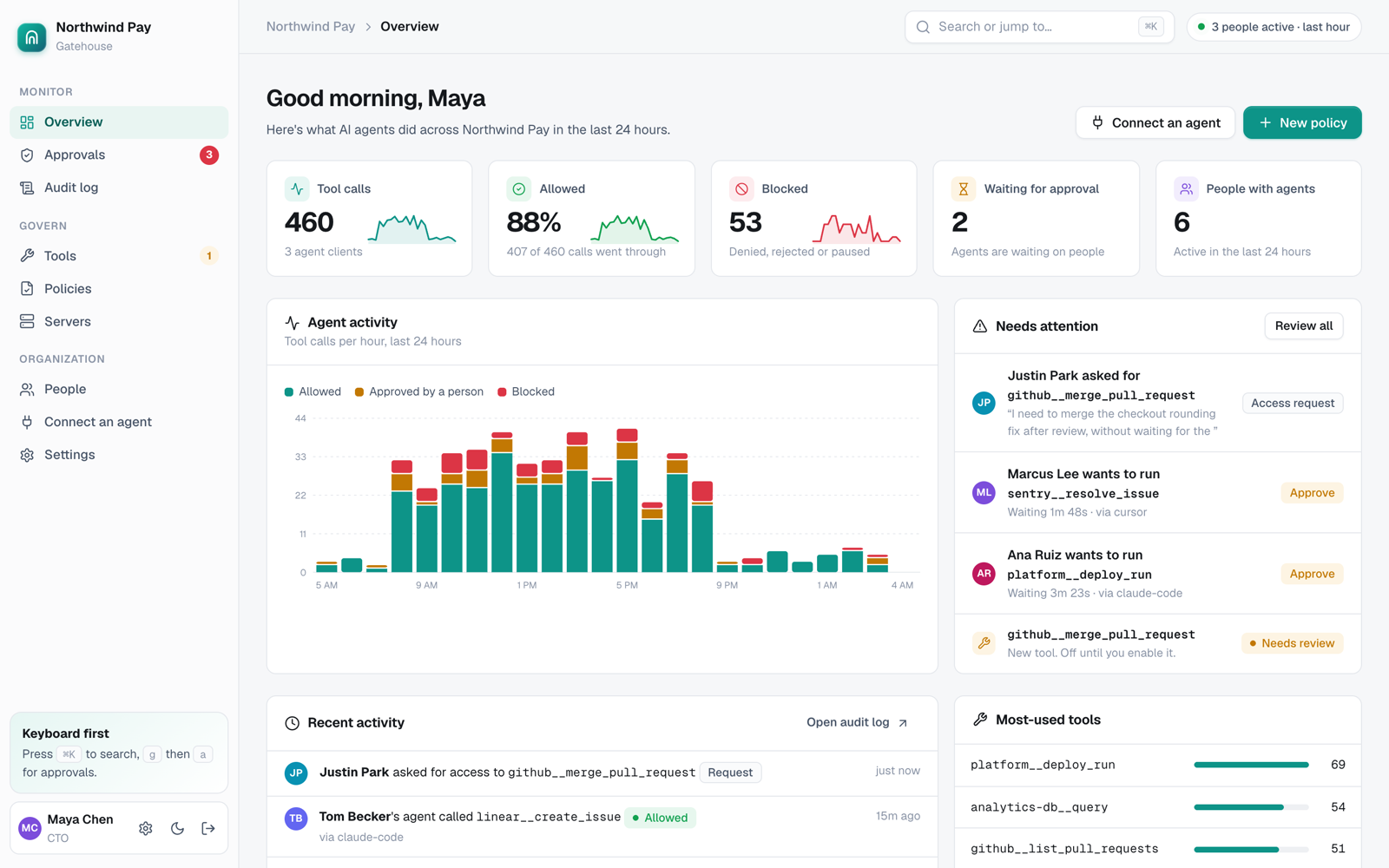
Every agent connects to one URL. Gatehouse signs the person in, checks each tool call against your policies, asks a person to approve when a policy says so, adds the real credentials without ever showing them to the agent, and records everything in a tamper-evident audit log.
Why it exists
AI agents now write code, query production data and deploy software. Without a gateway, each developer connects their agent to company systems with their own long-lived tokens. Nobody approves risky actions, nothing records what agents did, and a malicious or compromised tool server can instruct an agent to leak data.
Gatehouse gives security teams a way to say yes to agents with control they can prove.
What MCP is
The Model Context Protocol (MCP) is the open standard agents use to call tools.
- An MCP server connects one system to AI agents. GitHub, Linear, Sentry and many others publish official servers, and companies write their own for internal systems.
- A tool is one action a server offers, like
create_pull_request,run_queryordeploy. - An MCP client is the agent: Claude Code, Cursor, VS Code, Codex, or anything built with the MCP SDKs.
Gatehouse is both: a server to your agents, and a client to your MCP servers.
What you get
- One URL for every agent, with company sign-in.
- Default deny. New tools stay off until an admin reviews them, and calls no policy allows are refused.
- Plain policies by tool, group, person and argument values, with groups synced from Active Directory, LDAP, SCIM or SSO.
- Approvals in the console and Slack, with the exact call in front of the approver.
- Access requests from chat, so people can ask for tools they don't have.
- Credential brokering, so agents never hold secrets.
- Secret redaction in arguments and results.
- Tool-poisoning and rug-pull protection through definition pinning.
- A hash-chained audit log, exportable and streamable to your SIEM.
- Enterprise identity: SSO (Google, GitHub, OIDC, SAML), two-step verification, SCIM, roles, IP allow-lists.
- Self-hosting with Docker or Kubernetes.
Next, follow the quickstart to connect your first agent.